

Transients in audio are short, but crucial parts of (mainly) percussion samples. They help drums cut through the mix to make your track exciting and powerful.
What exactly is a transient?
Transient is a short burst of energy, mostly in the beginning of a sample. It gives the sound a feeling of "click", "snap" or just raw power.
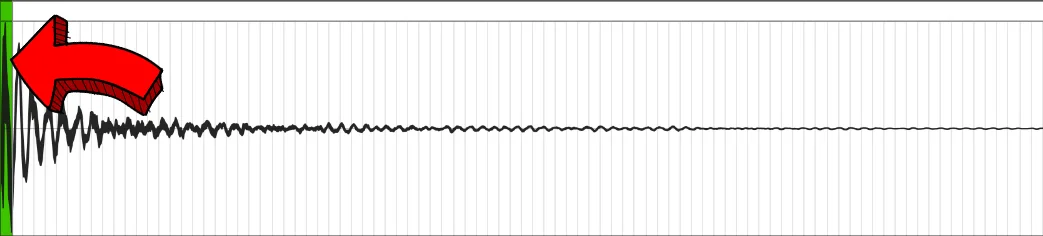
You can observe a transient by looking at most percussion samples. In an example below, I will show you the transient of a snare drum. Notice a large peak that stands out from the rest of the waveform in the beginning:
And now, listen to that snare sample:
This burst of power in the beginning that makes the snare powerful is exactly the transient. If we remove it, the same snare becomes weak, with no chance of pushing through all the instruments in a crowded mix:
At last, we can isolate the transient alone - the part of a snare without which we can't talk about hard-hitting drums:
Not all sounds will have such "snappy" transient. This especially applies to modern percussion samples for electronic music. Such samples are often already preprocessed for loudness - and this will sacrifice the transient. The kick drum you see below has a flatter waveform, where the transient stands out less:
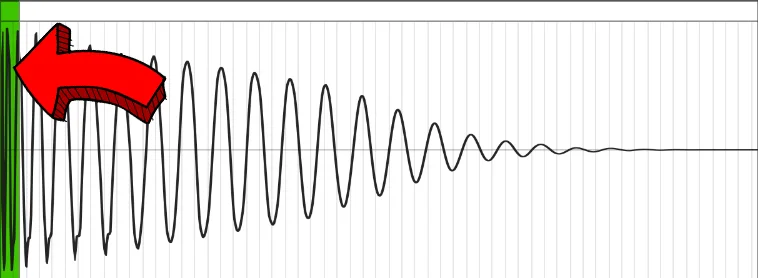
If you play this kick sample, you will hear it's less "clicky" compared to the snare from the previous example:
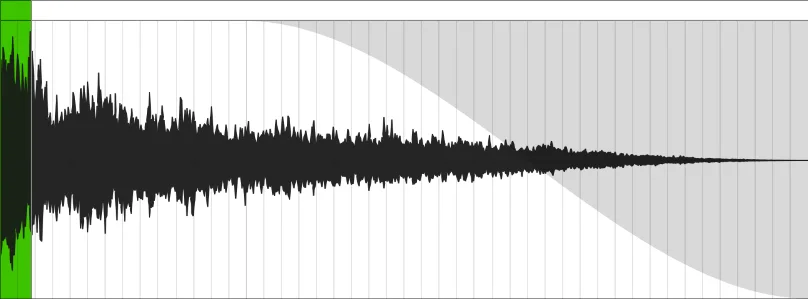
While kicks and snares are the sounds where the transient is most important, we can also find transients inside other percussion samples. In hi-hats or crash samples, the transient will weigh some importance as well:
Aside from drums, we can find transients in certain synthesizers, like pluck synths:
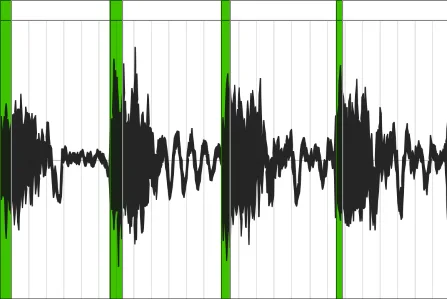
Or in vocals, where bursts of energy come mostly from explosive consonants like "p", "b", "t", "k", and so on:
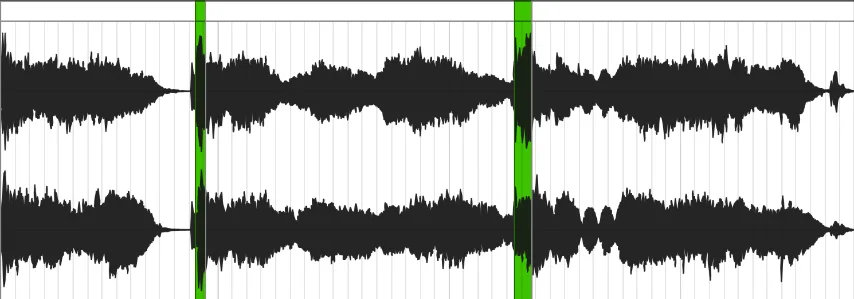
There are a few more types of sounds where transients are common, but I believe these examples are enough to understand, what exactly a transient is.
If you want to observe transients of samples on your own, be wary that some DAWs may automatically add a short fade-in and fade-out when dropping a sample. This is going to immediately weaken the transient if it's either in the beginning or the end of the sound. In Ableton, this may look like this:
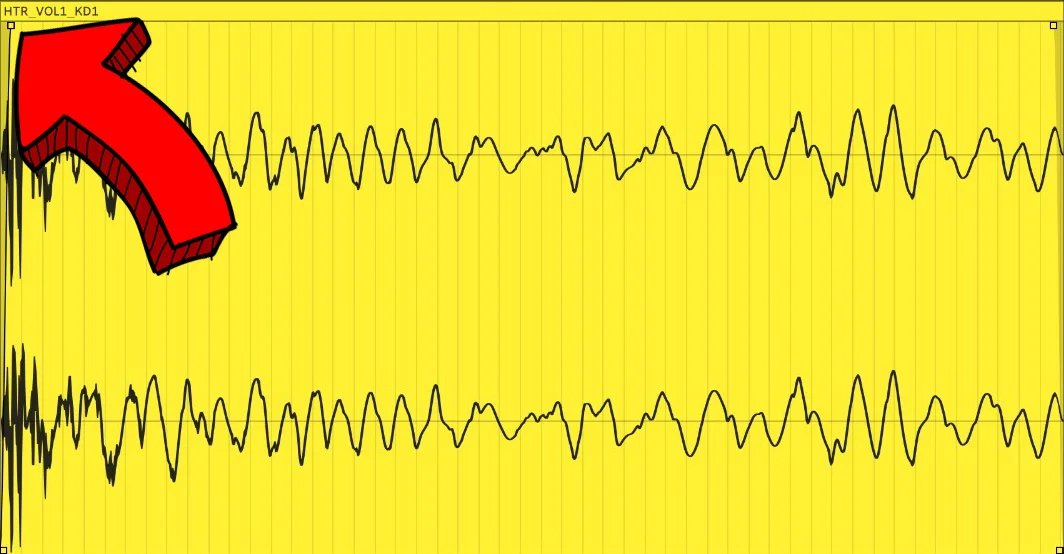
To fix that, open Ableton Preferences window by pressing CTRL (or Command) and "," keys. Then, in the Record, Warp & Launch tab, turn off the Create Fades on Clip Edges option:
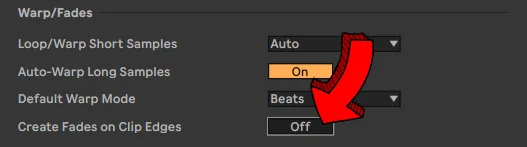
By default, Ableton adds these fades to reduce unwanted pops or clicks during sample playback. They happen mostly when either the beginning or the end of the sample has a peak volume higher than 0dBFS.
Having such loud peaks anywhere in your track is considered a mistake - you always should have enough headroom when working with music, so your mix can sound as best as possible.
Do transients have a specific length?
A straight-forward answer to this question would be: no, they don't.
The length of a transient depends mainly on 2 factors:
- The type of sound - whether it's a percussion sample, vocal or guitar recording. For example, a transient in a rimshot sample is going to be shorter than the transient of a boomy hip-hop kick drum.
- Our own perception of when does the transient begin and end. Two producers can look at the same sample, and perceive a different part of it as a transient. And both of them can be right!
These 2 reasons alone make the question difficult to answer in a specific way. But as long as you can precisely isolate that snappy and "clicky" part of a sample, its length is not important.
Why are transients important in a mix?
The main purpose of a transient is to give your sounds the right power to take as much space in the mix as they need.
Take this drum & bass track for example. If you listen to the kick and snare from 1:28 mark:

You will hear how much of a power both sounds pack. That is the transient's effect on the energy of the beat. Sounds exciting, right? But that's not the only thing a transient does.
Transients, especially in percussion sounds, help sounds to cut through the mix that sometimes can be full of synthesizers and other sounds playing in background.
Usually in the mix, most instruments (including the synthesizers and percussion sounds) are going to "compete" for the space in the mid frequencies range. And that's very easy to prove - if you use both a low and high-pass filter on the Master channel to isolate the frequency range from 300Hz to around 5kHz:
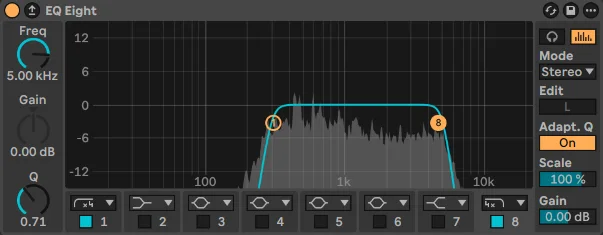
You are going to hear all parts of the track - the bassline, the kick drum, as well as hi-hats and pad synths. Listening to only the frequency range from 5kHz gives you just sizzling noise, and the sound of 20-300Hz range isn't as full as the midrange.
When you mix the track, you want to give each sounds its own place in the mix. Adjusting the volume levels is one way of prioritizing what sounds get more of that space.
On top of that, controlling the transient of each sound is another way of pushing certain sounds upfront or more to the back.
Transient processing is applied mostly to sounds that already have some transients - percussion samples are most common here. We can for example shape the transient of a hard techno kick drum.
By default, it's the sound that is going to be the loudest one in the mix (because the kick is the most important):
A common problem with such kicks is that due to the massive amounts of distortion, the original punch and transient of that kick dissapears. And having a weak kick in a track is disasterous.
This issue might not be so obvious when we listen to the kick in solo, so let's hear the kick in the context of the mix:
Since the kick is by default the sounds we push to the front most, turning up the kick volume even more is not always the right solution.
If I do that, the kick might cover every other sound, making the mix unbalanced. Listen to what happens to the kick once I add extra 3dB of volume:
Instead of making the kick louder, it's better to emphasize the weak transient of it.
How to enhance the transient?
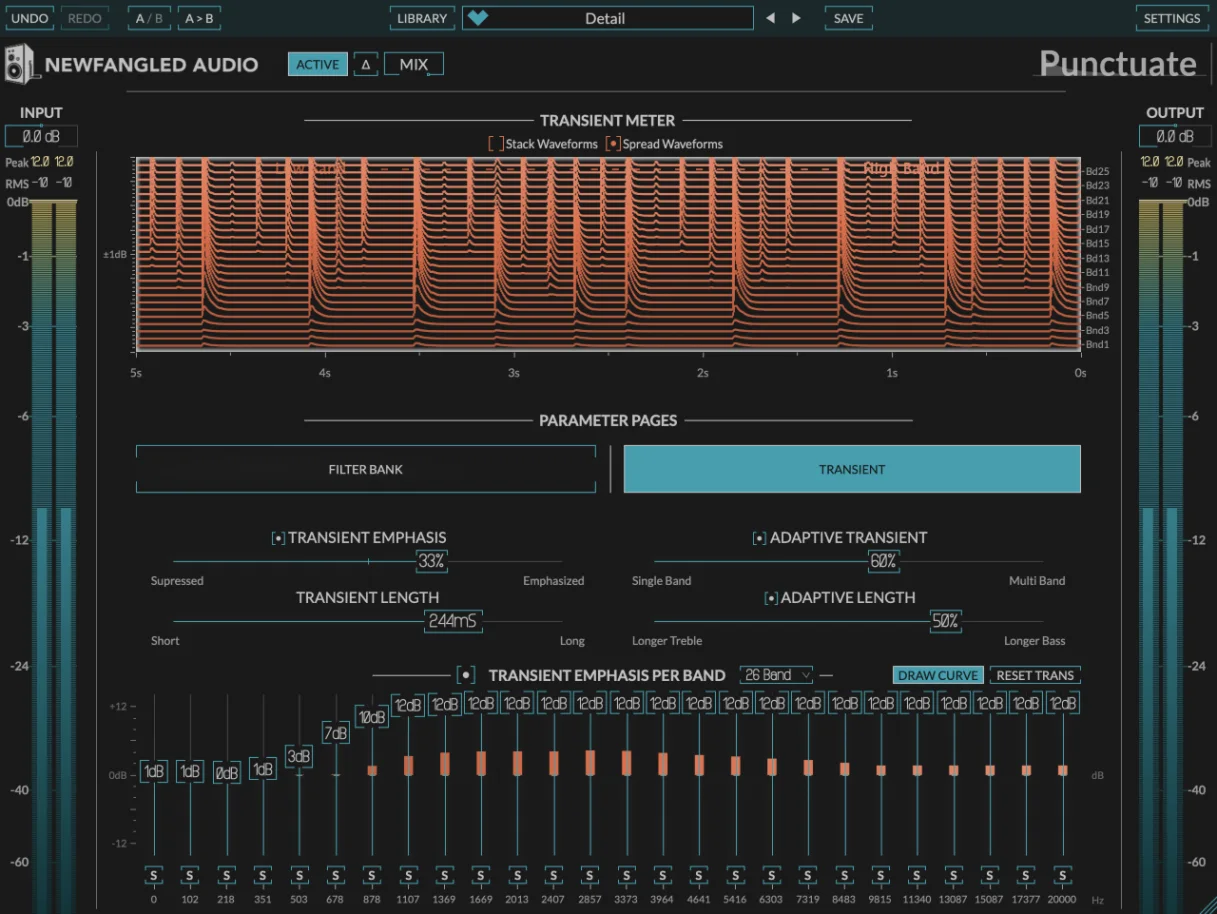
The easiest way to enhance the transient of a sound is to use a plugin called transient shaper. It gives a similar result to what a compressor, but usually has fewer knobs and is more beginner-friendly. One of the transient shaper plugins I love most is the Newfangled Punctuate. It works on great variety of sounds, and in its simplest form has only 4 faders to shape the transient:
This article has affiliate links. By using them to buy plugins, you help both plugin companies and me. If you like what you read, any support is appreciated.
To get started with shaping the transient, turn the Transient Emphasis fader to around 60%. This will make sure the transient is hearable well, and shaping it with remaining faders will become easier:

Adjust the Transient Length fader. This will have the largest impact over the transient, right after the Transient Emphasis fader. I recommend starting with 30ms, where the transient (even after lots of emphasis) sounds very thin:

Gradually turn up the Transient Length fader until you hear the kick becomes too "heavy". Then, dial the Transient Length back a bit, and move over to both Adaptive Transient and Adaptive Length faders:
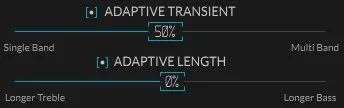
They both control the tone of a transient, but in a different way. By tweaking these faders, you can expect the transient to be emphasized more in either the midrange or the high-end. My tip is to try out extreme settings at first to get an idea of how these faders work.
The last step is to return to the Transient Emphasis fader to adjust it to a more appropriate value.
It's important to do this with other sounds playing in the background. After all, the goal of transient shaping is to make the kick cut through the mix, so playing all instruments together is only logical. In mixing, working with instruments in solo rarely works.
Let's compare now the kick before and after using the Newfangled Punctuate. This was the beat with a kick that didn't have a transient shaper used:
The same kick after using the transient shaper is now much more present - and that's without touching the volume knob!
The beat you have just heard comes from my hard techno Ableton template that contains a fully arranged track, with full mixdown and SLVL/USH style kick drum. By analyzing the raw Ableton Live Set, you will learn much more than just how to work with a transient shaper.
Does every sound need a transient shaper?
As you have seen above, kick drum is a sound where using a transient shaper makes most sense.
We also know that there are many other sounds with transients, like hi-hats or pluck synths. Does it make any sense to tweak them as well?
Fortunately, not so much. In genres like techno (especially when we talk about aggressive styles of techno), it's more common to reduce the peaks of many sounds by (for example) turning the Transient Emphasis fader to the left:

The reason for that is the loudness. A weaker transient that doesn't stand out much will make the whole sound (on average) louder.
If we apply such processing to numerous sounds in the track, we will finish with a more dense mix that will become loud after mastering.
"But won't such processing make the mix lifeless and without punch?" - if you ask yourself this question now, don't worry. Quite often it's the opposite - a dense mix that has all the sounds glued together is a recipe for a mix that is full of energy. That's exactly the reason why compressor and limiter effects are used today so often.
Also, the transient alone is not the only factor that defines the power of your mix.
Sample selection, skillful layering and equalization are just a few other parts of a track production that define how powerful a track is. In my opinion, they are even more important than the transient itself.
Are there other ways to control the transient?
Of course! Transients can be affected in multiple ways, even as a side effect. The most common example would be the compression and limiting. Let's bring back the vocal sample, where I pointed out its transients:
If you listen to the vocals below, you will hear the transient that comes from explosive consonants in the words "coming" and "tonight":
After using a limiter, the same vocal is going to have these peaks reduces, leading to a less "explosive" sound:
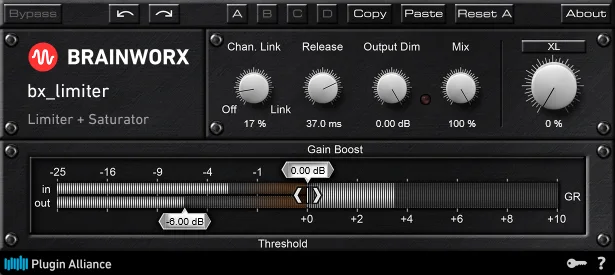
If you listen to the vocals now, you will notice they carry less of an impact:
By reducing these peaks, vocals sound more consistent which helps them sit in the whole mix. Without such compression, vocals could poke through the kick drum or hi-hats, making the listening experience more distracting.
Other common ways to control the transient are following:
- Saturation and distortion (these effects reduce the transient)
- Automated EQ (depending on the automation, it can either empahsize or reduce the transient)
- Tweaking the volume envelope (controls the transient in both ways, mainly in synthesizers)
Because this article is mainly about what a transients is, I will not cover here above techniques that are sometimes less common and more experimental. Instead, I recommend you to watch my YouTube tutorial below that goes more in-depth about different transient shaper plugins. You will see more kick drum examples, including the example of shaping the transient through automated EQ:


